Toilet Repair Services in Fountain Valley
📞 Call Now — (714) 410-0362The repair services
The nine core repairs. Together they cover nearly every call that comes in from Fountain Valley homes.
Seats, bidets, seals and supply lines
Four focused services for the jobs that sit between a full repair and a full replacement.
How to choose the right page
Work from the symptom, not the part name. If the toilet runs, start at running toilet repair — the cause is usually in the tank. If it leaks, the leak page helps you place the water first; base leaks often end at the wax ring page. If it flushes weakly, the fill and flush valve page covers tank level, jets and valves together. If it rocks, go straight to flange repair. And if it is simply old — stained, cracked, or clogging no matter what — the replacement page helps you weigh one more repair against a new toilet.
Rentals, offices and multi-unit buildings
Toilets in rentals and workplaces fail the same way home toilets do — they just serve more people and get reported later. Landlords and property managers in Fountain Valley can use the same number for tenant calls, shared restrooms and multi-toilet visits. Mention the number of toilets and the building layout on the call so one visit covers the whole list.
What every service visit includes
Test before touching
Flush, fill, seal, base and supply are all checked first, so the repair targets the cause you called about — and anything quietly failing behind it.
Scope confirmed with you
The technician explains the findings in plain language and confirms the scope of the work with you before a part comes off.
Common parts on hand
Flappers, fill valves, flush valves, wax rings, supply lines, seats and handles are standard stock, so most visits finish in one trip.
Tested before it counts as done
Several test flushes, a dry-base check, and a look at every connection that was touched. You see the toilet working before the job closes.
Services — FAQs
How many toilet services does the Fountain Valley service list include?
Thirteen: clogged toilet repair, running toilet repair, leak repair, replacement, installation, parts repair, flange repair, fill and flush valve replacement, urgent repair, seat replacement, bidet installation, wax ring replacement, and supply line and shut-off valve replacement.
Which toilet service do I need if I only know the symptom?
Start with the symptom. Running or refilling points to the running toilet page; water at the floor points to leak repair or the wax ring page; a weak flush points to the fill and flush valve page. If you are still unsure, call and describe what you see — the call sorts the job before anyone is sent.
Do the services cover rentals and offices in Fountain Valley?
Yes. Landlords, property managers and small offices in Fountain Valley can use the same number for tenant toilets, shared restrooms and multi-unit buildings. Mention how many toilets and where they are when you call so the visit is planned in one trip.
What does a toilet service visit include in Fountain Valley?
Testing first: flush, fill, seal, base and supply checks to find the real cause. Then the scope is explained and confirmed with you before work starts. After the repair, the toilet is flush-tested several times and the connections are checked dry.
Are the toilet services available outside Fountain Valley?
Yes — the same services reach Costa Mesa, Garden Grove, Huntington Beach, Santa Ana and Westminster. Each city has its own page under Areas We Serve with notes on its housing stock.
Reading a symptom the way a technician does
Every service above starts from a symptom, and symptoms speak a fairly consistent language. Before any part is touched, a toilet visit sorts what you are seeing, hearing, smelling or feeling into one of a few families — because each family has its own short list of causes, and testing in the wrong family wastes the visit.
Sounds, sights, smells, movement
Sounds come first because they are the most specific. Running water that never stops is a seal failing somewhere between the tank and the bowl. A hiss points at the fill valve. A short refill cycle every so often, in a quiet house, is the flapper letting water slip past and the tank topping itself up. Gurgling is different in kind: it is air moving through water, which means the drain or the vent is involved, not the tank.
Sights narrow it further. Water on the floor at the base is a seal or supply problem until proven otherwise; water inside the tank sitting below the marked line explains a weak flush without any blockage at all; rust-colored streaks under the rim point at the jets and the water that feeds them. Smells near the base, in a bathroom that is otherwise clean, almost always mean sewer gas finding a path — the wax seal or a dry trap nearby. And movement — a bowl that rocks, shifts or creaks — is the floor connection asking for attention, the one symptom that gets worse every single time the toilet is used.
Why one visit covers the whole tank
The parts inside a tank age together. They share the same water, the same mineral load and roughly the same number of flushes, so when a flapper has worn to the point of leaking, the fill valve of the same age is usually not far behind it, and the flush valve's seat has the same crust as the flapper that seals against it. This is why the fill and flush valve page describes a tank rebuild as a single job: swapping the full set of working parts in one visit resets the tank's clock, instead of returning three times in a year for three parts that were all installed together.
The same logic applies at the base. A toilet that is already lifted for a flange repair gets a fresh wax seal as a matter of course, and a toilet being set for the first time in a remodel gets its flange height checked before the bowl goes down, not after a leak announces the mistake. Grouping the work while the toilet is already apart is not upselling — it is the difference between paying attention to labor once and paying attention to it three times.
Landlords, offices and property managers: the services above cover rental homes, small offices, restaurants and shops across the coverage area, where a toilet out of service is a working problem, not just an annoyance. A single call can describe several units or several bathrooms at once; the visit is then planned around access — keys, tenants, business hours — rather than discovered one locked door at a time. For multi-bathroom buildings, saying on the call which bathrooms share a wall or a stack helps, because shared stacks are where one bathroom's symptom sometimes belongs to another bathroom's cause.
The parts, in plain words
Toilet work uses a small vocabulary. These are the six parts behind nearly every service above, described the way they would be described at your bathroom door.
The flapper
The rubber seal at the bottom of the tank that lifts to let water into the bowl and drops to close the flush. It is the hardest-working soft part in the toilet and the first to warp, stiffen or crust over — which is why it sits behind most running-toilet calls. It is also the part a homeowner can most reasonably swap after reading the flapper guide, with the water off and the tank drained.
The fill valve
The tower in the tank that refills it after a flush and shuts off at the water line. When it ages, it hisses, runs long, refills in short bursts or stops filling at all. Its intake screen is also where hard-water grit collects first, so a fill valve in Fountain Valley lives a harder life than the same part in a soft-water city.
The flush valve
The tower the flapper seals against, standing over the large hole between tank and bowl. Its seat is the surface that decides whether a new flapper actually seals; a pitted or crusted seat will leak past a fresh flapper, which is why a running toilet sometimes needs the pair replaced together rather than the flapper alone twice.
The wax ring
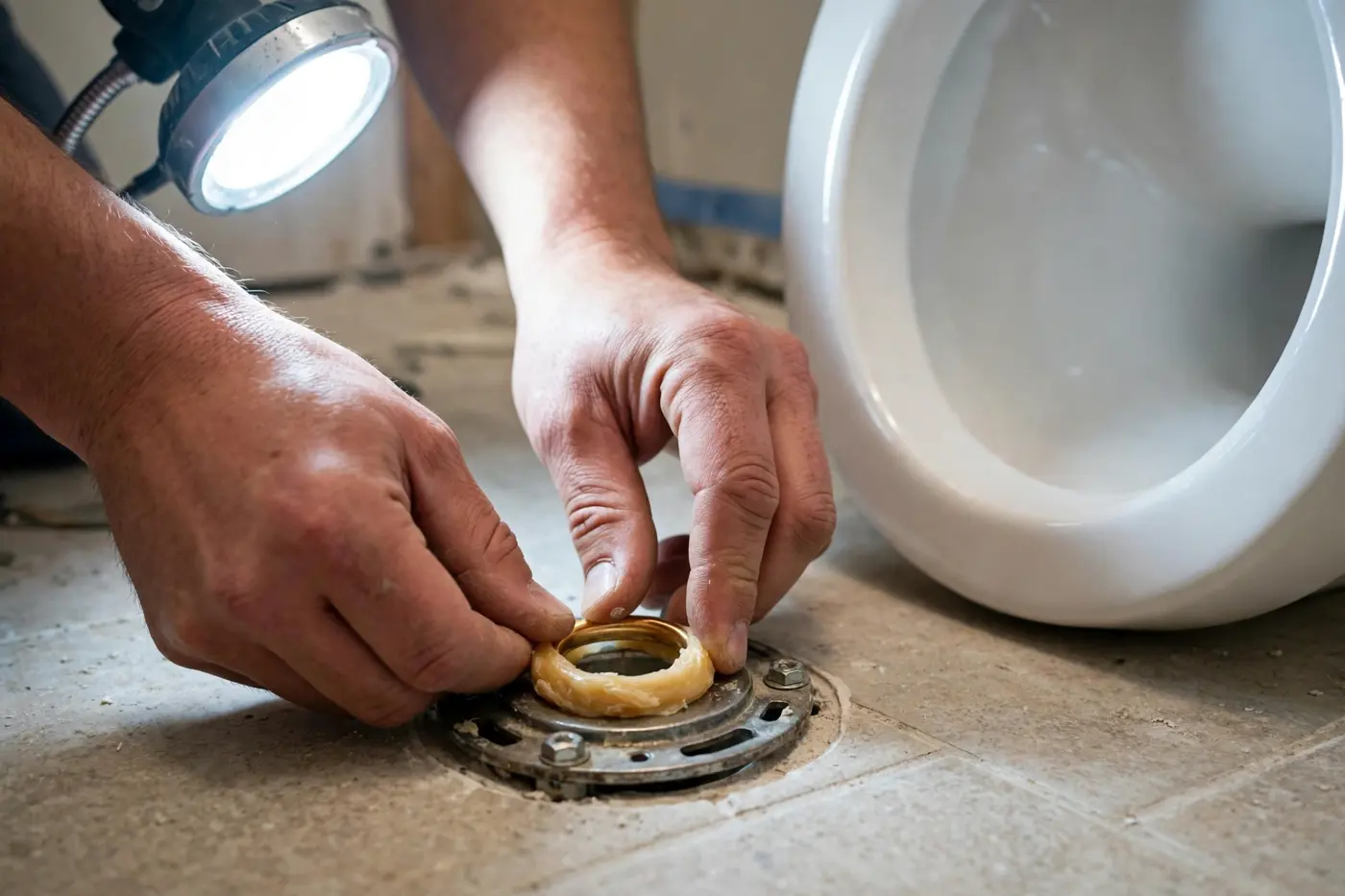
The soft seal compressed between the bottom of the toilet and the floor flange. It never gets seen once the toilet is set, and it only complains indirectly — through a sewer smell, a damp base or a rocking bowl. It cannot be topped up, patched or tightened; the toilet comes up, the old wax comes off, and a fresh ring goes down. Small part, whole job.
The flange
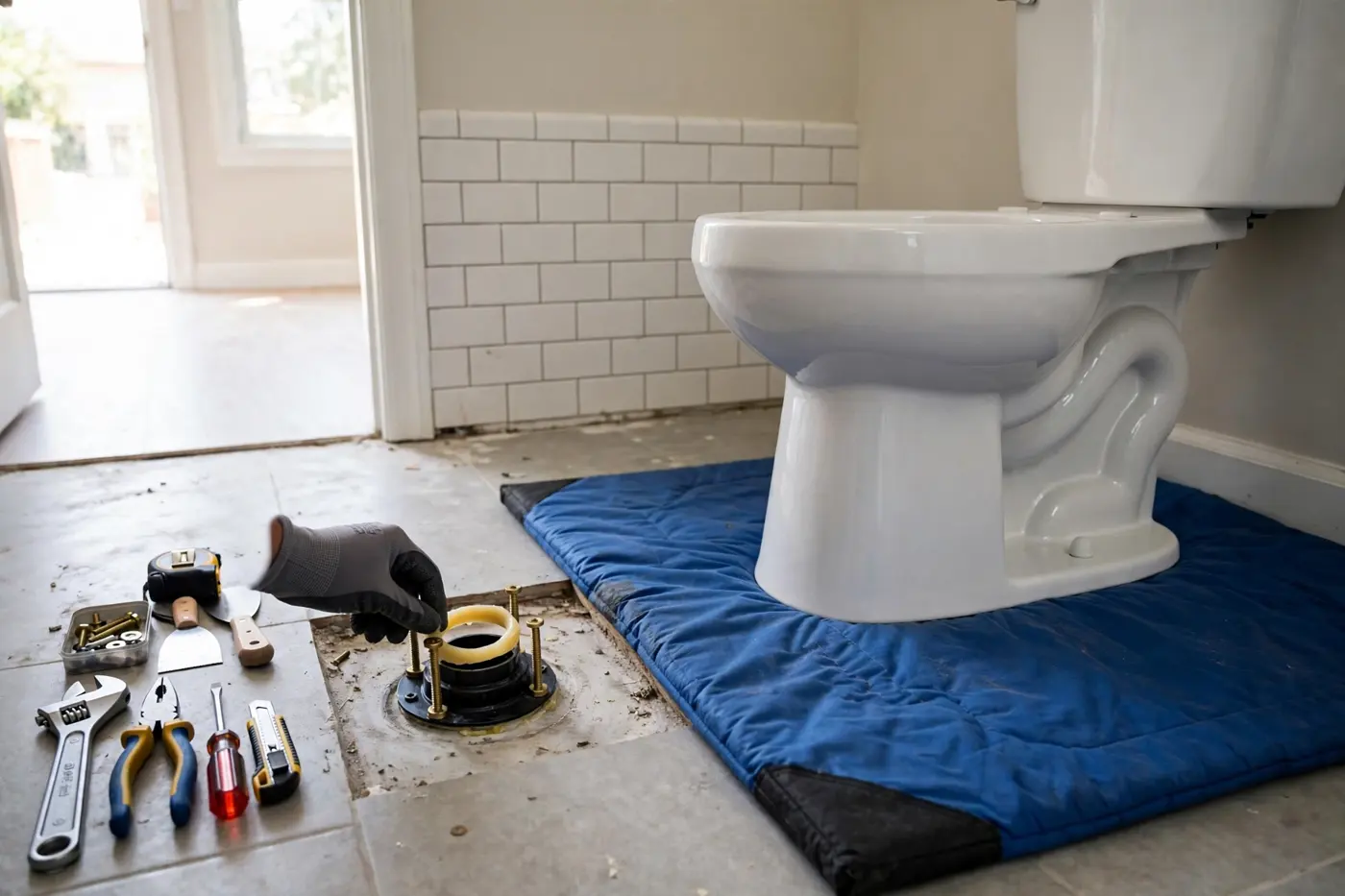
The ring at floor level that the drain pipe ends in, the wax seals against, and the toilet bolts down to. Its height relative to the finished floor decides whether any wax ring can seal at all. Flanges crack, corrode and sit too low after floor remodels, and every one of those faults shows up disguised as a leak that looks like something else.
The supply line and valve
The short line from the wall valve to the tank, and the valve — the angle stop — that controls it. Together they are the toilet's only path to the house's water and its only emergency shut-off. A valve that will not turn and a line that has gone stiff with age are the two quiet risks in most bathrooms, and both are found by the simple habit of testing the valve once a year.
When one service turns into two. Symptoms overlap, and honest diagnosis sometimes crosses service lines mid-visit: the running toilet that turns out to need a flush valve seat as well as a flapper, the base leak that reveals a low flange once the toilet is lifted. When that happens, the finding is explained before any further work — what was expected, what was actually found, and what the options are — and the second job is only done with a clear yes. A visit booked for one service never silently becomes three.
Not sure which service fits?
Call (714) 410-0362 during open hours and describe the symptom. The right service gets picked on the call — Mon–Fri 7–10, Sat 8–10, Sun 7–9.
📞 Call Now — (714) 410-0362 Prefer email? info@toiletrepairfountainvalleyca.com