Quick answer
Problem: Hard water leaves mineral scale that stiffens flappers, jams fill valves, and narrows rim jets, causing running, weak flushes, and stains.
Solution: Check the flapper edge, fill valve shutoff, and rim jets on a regular schedule, and replace parts that scale has roughened or warped.
When to call: If the toilet runs, refills on its own, or flushes weakly after basic cleaning, call for fill valve and flapper service during open hours.
In this guide
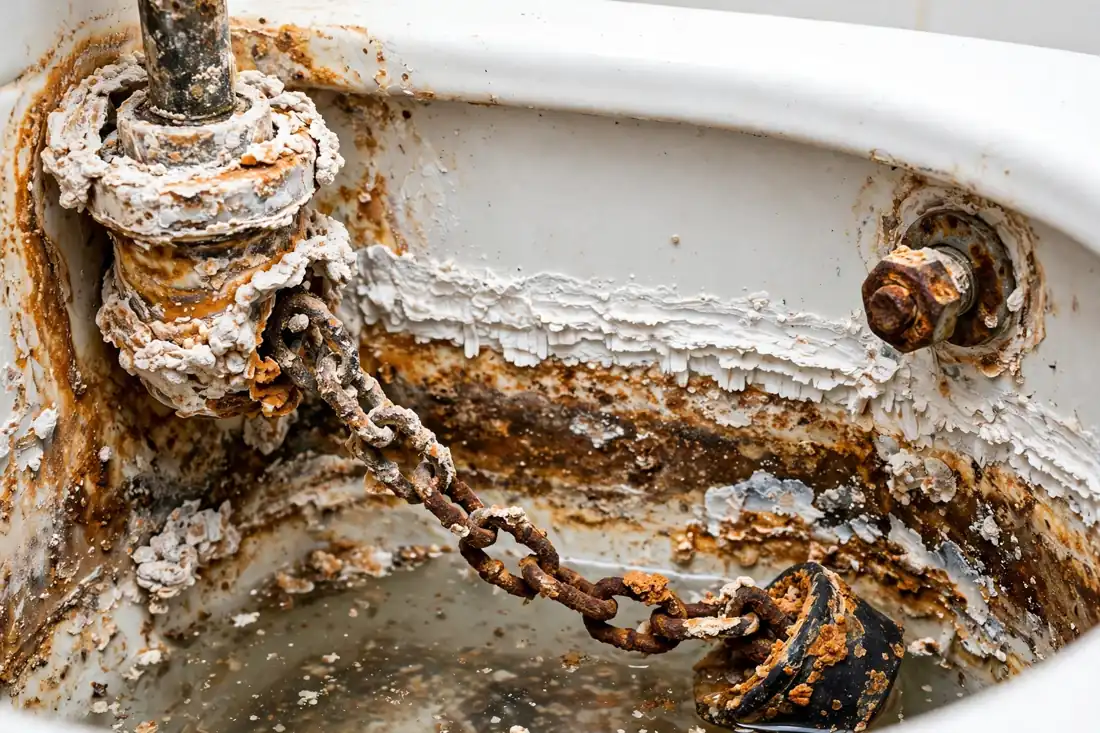
The water in Fountain Valley is hard. That is not a guess or a sales line. The City of Fountain Valley Water Quality Report lists hardness at about 217 parts per million, which works out to roughly 13 grains per gallon. Water at that level carries a steady load of calcium and magnesium. You see the result as white crust on faucets and spots on shower doors. Inside your toilet, where parts sit in water all day and night, the same minerals settle in places you rarely look. Over months and years, that quiet buildup changes how the toilet seals, fills, and flushes.
This guide explains the damage step by step. You will see which parts fail first, what the early signs look and sound like, and which checks you can do with the tank lid off and no special tools. You will also learn the point where cleaning stops helping and a fresh part is the sound fix. If your toilet already runs or flushes weakly, our running toilet repair page and valve replacement page cover the service side in detail.
The local numbers behind the scale
Hardness measures dissolved minerals in water. At about 217 parts per million, Fountain Valley water sits in the hard range. Every tank refill brings more minerals into the tank. Some minerals stay in solution. Others settle out on surfaces, mainly where water sits still or flows through narrow openings. A toilet tank is an ideal place for scale. Water rests there for hours between flushes. The flapper sits submerged. The fill valve opens and closes through gritty flow. The rim jets in the bowl are small holes, easy to narrow.
Scale grows slowly, which is why the damage sneaks up on people. A flapper that sealed fully last year leaks a thin stream this year. A fill valve that shut off with a clean click now hisses for a minute after each refill. A flush that once swirled strongly now looks lazy. Each change is small on its own. Together they waste water, weaken cleaning, and raise the odds of clogs and leaks. Knowing the local water is hard helps you read those small changes as a pattern rather than bad luck.
Homes near Mile Square Park, Green Valley, and the older central tracts share the same city water, so the pattern shows up across Fountain Valley. Age adds to it. In 1960s and 1970s homes, some tanks hold a mix of older and newer parts. Older rubber hardens with age even before minerals attack it. When hard water meets aged rubber and narrow jets, wear speeds up. That is why technicians here ask about running and refill sounds early in a visit. Those sounds often trace straight back to scale.
Step 1: See what scale does to the flapper
Feel the flapper edge for stiffness and crust
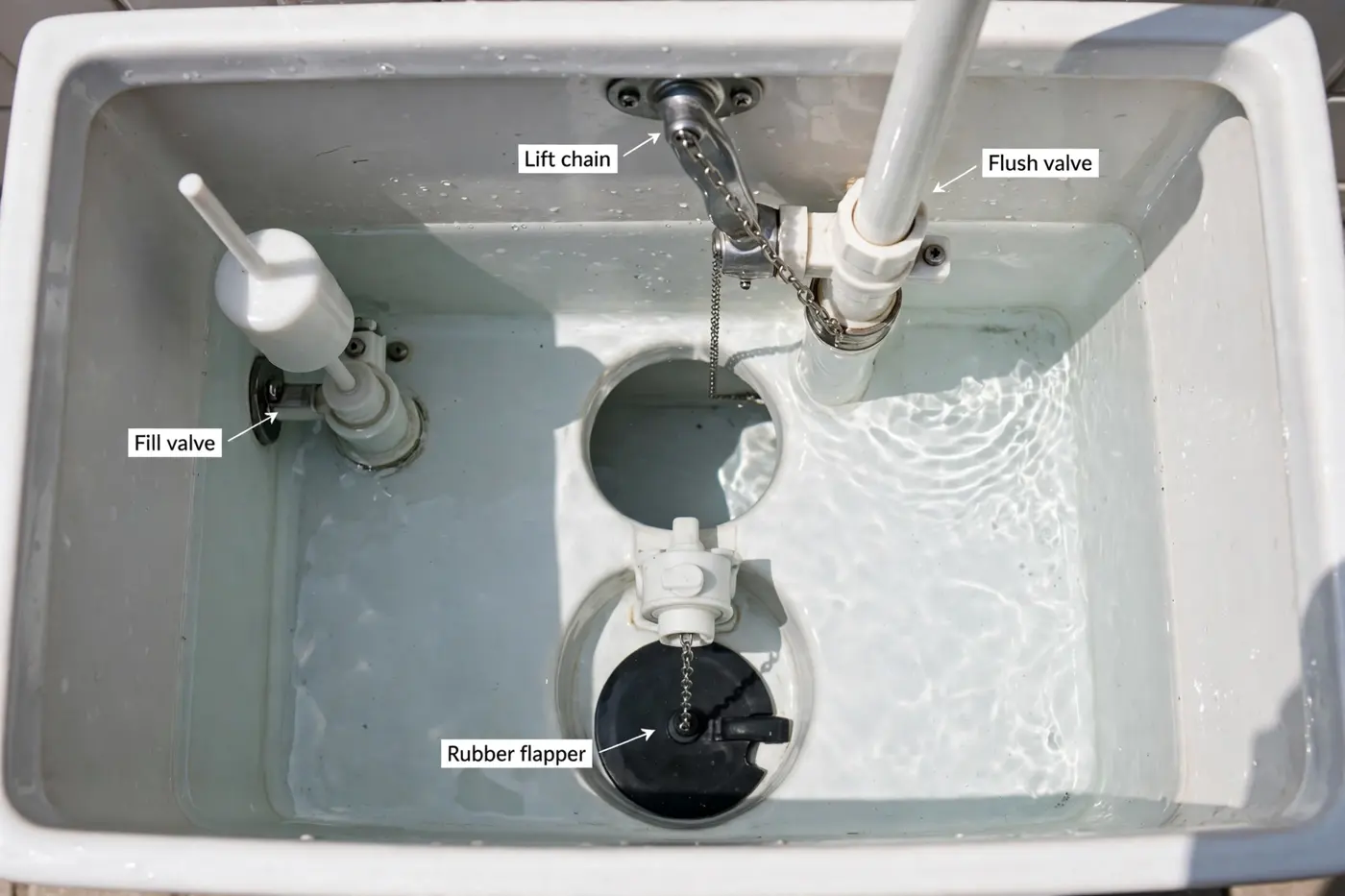
Turn off the water at the wall valve, flush to empty the tank, and lift the flapper. Run a fingertip around its sealing edge. A healthy flapper feels soft and smooth. A scaled flapper feels stiff, rough, or bumpy, and may show white or tan crust. That rough edge cannot sit flat on the flush valve seat, so tank water leaks into the bowl in a slow, steady path. The leak causes running, phantom refills at night, and a faint ripple you can see on the bowl water.
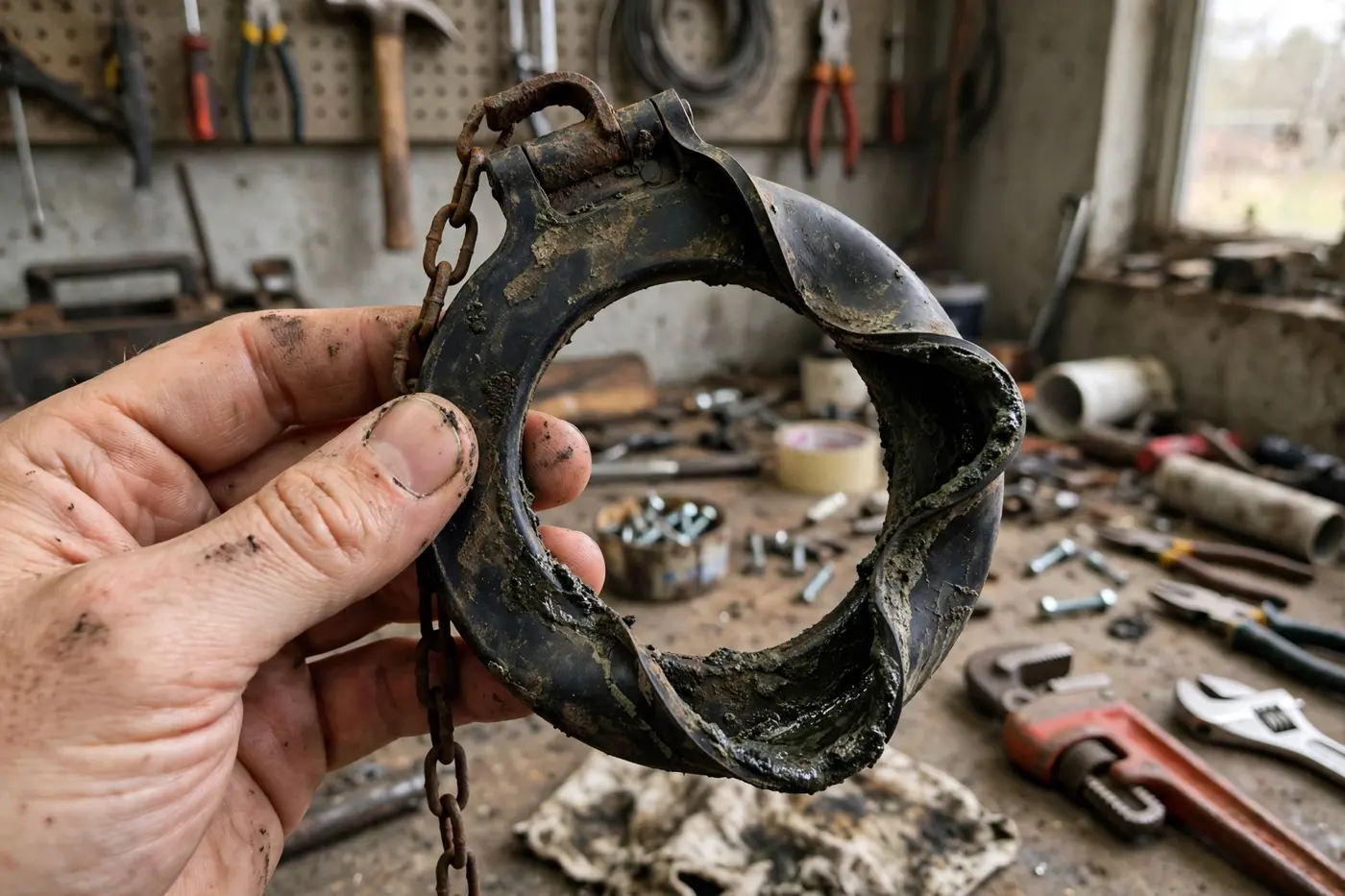
Wiping light crust off can help for a short time. Once the rubber itself has stiffened or warped, wiping does not restore the seal. Press the flapper flat with your palm. If it springs into a curl or will not lie flat, the material has changed shape. Replacement is the fix at that point. Fit matters. The new flapper must match the flush valve size and sit centered. A dye test after fitting confirms the seal. If color still reaches the bowl with a fresh flapper, the seat below is pitted, and a technician should address the valve itself.
Scale on the seat matters as much as scale on the flapper. Even a soft new flapper cannot seal against a rough stone-like ring. During service, the seat is checked by touch and by dye test. That two-part check prevents the common cycle where a homeowner replaces flappers again and again while the true fault, the seat, goes untouched.
Step 2: See what scale does to the fill valve
Listen to the shutoff and watch the water line
Flush and stand by the open tank. A healthy fill valve fills at full flow, then stops in a clean moment. A scaled valve may fill slowly, whistle or hiss, stop and start, or keep seeping after the tank looks full. Grit and scale inside the valve cap block the small passages that control shutoff. Watch the overflow tube as well. If water keeps spilling down the tube, good water is going straight to the bowl with every refill cycle.
Fill valve trouble wastes water in two ways. A valve that will not shut off sends a constant stream down the overflow tube. A valve that fills slowly through grit may also leak at its seals and add moisture where it does not belong. Some valves can be flushed clean by removing the cap and letting water wash grit out, with the supply handled carefully. That rinse helps when grit is loose. It does not help when seals have hardened or the valve body is worn. A technician tests shutoff after cleaning and replaces the valve if the hiss or seep remains.
Supply parts deserve a look during the same check. The line that feeds the valve and the wall shut-off valve itself also meet hard water daily. A stiff wall valve that will not fully close makes every future repair harder. Our supply line and valve page explains those parts. Checking them while the tank is open takes little extra time and prevents a surprise during the next repair.
Step 3: See what scale does to the rim jets
Feel under the rim and watch the swirl
With gloves on, run a finger under the bowl rim and feel the jet openings. Healthy jets feel like clean, open holes. Scaled jets feel crusty, with some holes partly or fully blocked. Then flush and watch. Strong jets send angled streams that spin water around the bowl. Blocked jets produce a weak, uneven wash that leaves paper and waste behind. Hold a small mirror under the rim if you want to see the crust directly.
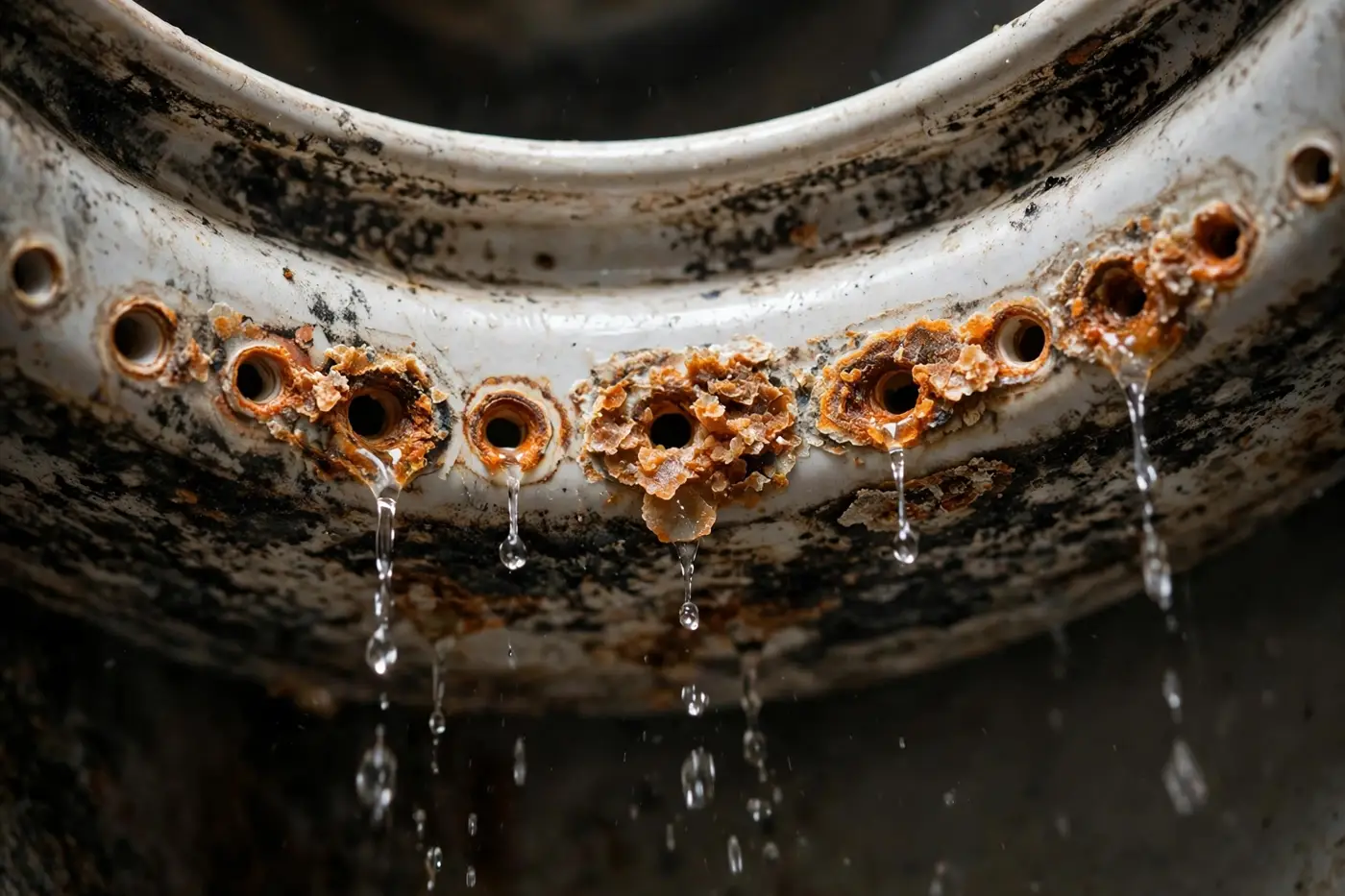
Homeowners sometimes clear one or two jets with a small pick or wire. Work gently if you try, since porcelain chips if tools slip. Clearing helps when only a few jets are blocked. When many jets are narrowed and the siphon jet at the front of the bowl is also crusted, the flush may stay weak even after poking each hole. At that stage, repeated clogs are likely. See our clogged toilet service if clogs have already become a pattern. A technician can judge whether jet clearing, tank parts, or both will restore a strong flush.
Stains, rings, and what they signal
Hard water also leaves marks you can see without opening the tank. A tan or rust-tinted ring at the bowl water line, chalky streaks under the rim, and white crust at the base of faucets nearby all point to mineral-heavy water at work. Bowl stains alone are a cleaning matter. Stains plus running sounds, slow refills, or weak flushes are a parts matter. Read the full set of signs together. One sign can mislead. Three signs pointing the same way rarely do.
Do not use harsh acid cleaners inside the tank. Strong chemicals can attack rubber seals and metal parts, turning a scale problem into a leak problem. Bowl cleaners belong in the bowl only, used as their labels direct. In-tank drop-in tablets are also a poor choice. Their chemicals sit against the flapper for weeks and shorten its life, which is the opposite of what hard-water homes need. Plain checks and timely part replacement protect the toilet far better than strong chemicals.
Habits that slow the damage
You cannot change city water at the toilet, but you can change how fast scale wins. Lift the tank lid twice a year and look. Feel the flapper edge. Listen to one full refill. Feel under the rim for crust. These checks take five minutes and catch wear while it is still a single part, not a set of problems. Fix small leaks fast. A leaking flapper keeps fresh mineral water moving through the tank all day, which feeds more scale in more places. A sealed tank sits still, and still water lays down scale far more slowly.
When a part does fail, replace it fully rather than nursing it along for months. A fresh flapper on a checked seat, or a fresh fill valve with a clean shutoff, resets the clock on that wear path. If hard water has affected several parts at once, a technician may suggest renewing the tank parts together in one visit: fill valve, flapper, flush valve parts, and supply line checked as a set. The scope is confirmed with you before any work starts. Confirm your area on our areas we serve page, and call during open hours when you are ready.
Frequently asked questions
How hard is Fountain Valley water for a toilet?
The City of Fountain Valley Water Quality Report lists hardness at about 217 parts per million, which equals roughly 13 grains per gallon. That level counts as hard water. It leaves mineral scale on tank parts, rim jets, and seals with normal daily use over time.
Which toilet parts does hard water harm first?
Flappers and fill valves usually show wear first because they sit in tank water all day. Scale stiffens flapper edges so they leak, and grit in the fill valve keeps it from shutting off cleanly. Rim jets narrow next, which weakens the flush and leaves the bowl less clean.
Can I remove hard water scale from my toilet tank parts myself?
Light crust on a flapper edge or jet opening can sometimes be wiped or gently brushed away after shutting off the water. Heavy scale that has pitted rubber or narrowed many jets rarely cleans up well. At that point, replacing the worn part restores the seal and the flush more reliably.
Does hard water cause a toilet to run or clog?
Yes, it can do both. A scaled flapper leaks and causes running and phantom refills. Narrowed rim jets weaken the swirl that clears the bowl, so paper is left behind and clogs form more often. Checking both the tank parts and the jets gives the full picture.
How often should hard water toilet parts be checked in Fountain Valley?
A quick tank check once or twice a year suits most homes. Look at the flapper edge, listen for hissing after a refill, and feel under the bowl rim for crusty jets. Homes that see repeat running or weak flushes should have the parts checked sooner by a technician.
Also read
Read next our guide on how much water a running toilet wastes and our guide to replacing a toilet flapper. For service, see fill valve and flapper replacement and browse all areas we serve.